
Re-testing BEFORE testing: a practice-oriented assessment model
Helping students learn from mistakes on exams while keeping my grading load manageable

One of the most common features of alternative grading is the ability for students to reattempt assessments without a grade penalty. Robert Talbert and David Clark identified reattempts without penalty as one of the four pillars in their Grading for Growth book. It reinforces a growth mindset by turning assessments into learning opportunities: For students who don’t do well on the test, they have an opportunity to learn from their mistakes and try again.
Structuring a grading system around the opportunity to reattempt assessments is a powerful way to encourage real learning. In practice, however, I’ve found that it significantly increases my grading load. Rather than grading one exam for each of my 40 students, built-in reattempts mean I have 10 or 20 or even 30 more to grade, depending on how many students reattempt the exam. There is also evidence that if exam re-takes are optional, they can exacerbate equity gaps, because students with commitments related to work or family are less likely to attend exam re-takes outside of class hours.
To incorporate reattempts in a way that equitably supports student learning and makes my grading load sustainable, I started using a unique “re-testing before testing” assessment model. Here’s how it works.
The assessment structure
A major assessment in my community college Introductory Biology course is the Essay Exam. Each Essay Exam has 8 questions that target higher-level skills on Bloom’s taxonomy. Since the questions require students to apply and synthesize knowledge, the Essay Exams are open-note: students complete them on paper in class without access to electronic resources.1 Each question requires approximately a paragraph-length written response. Completing the 8-question Essay Exam takes most students the full 75-minute class period.
There are 3 Essay Exams in the 16-week semester. For each Essay Exam, I dedicate a full week of the course, largely to support the practice opportunities. Before students take the actual Essay Exam, I give them two opportunities to practice. One of those opportunities becomes the re-test opportunity later.
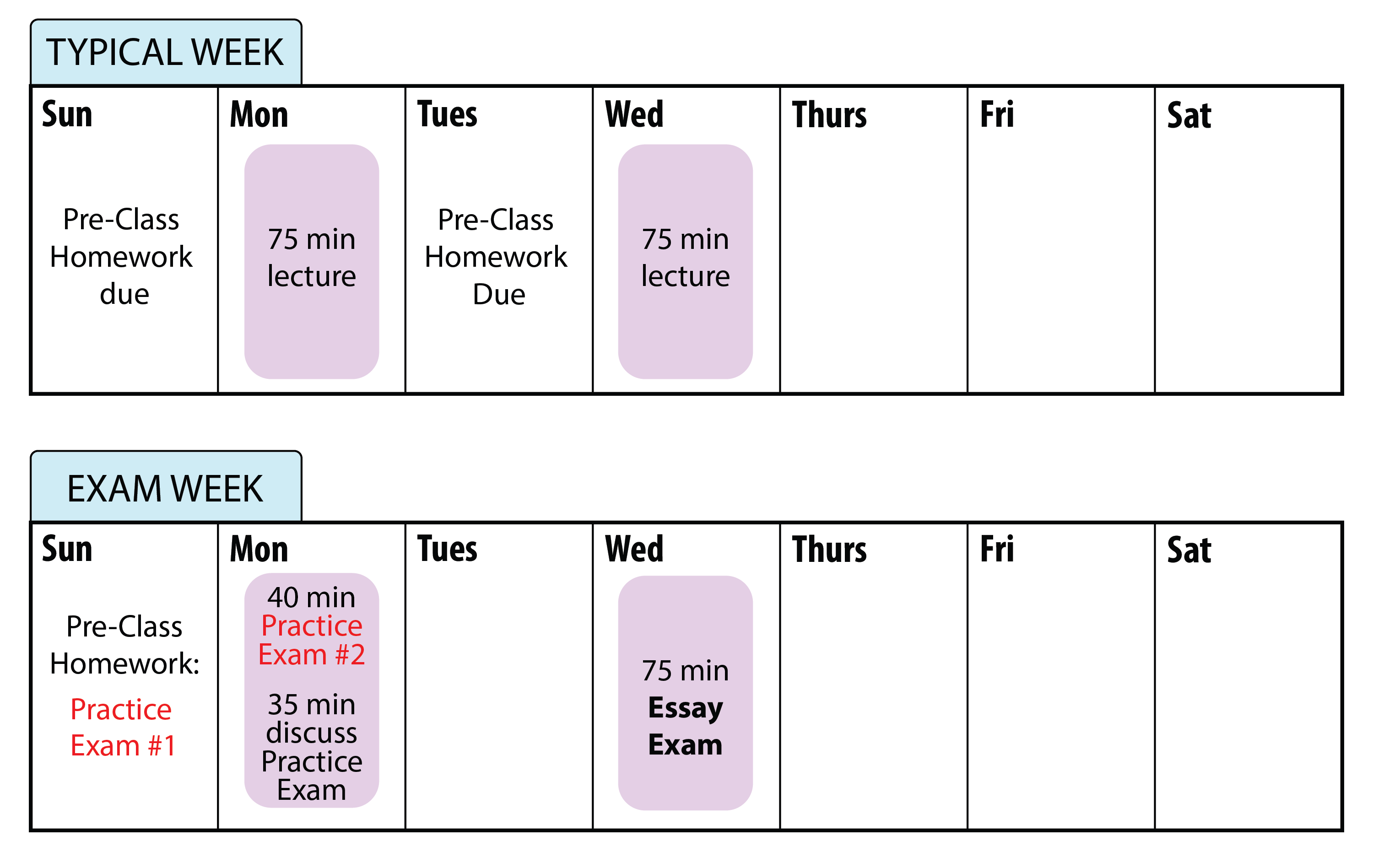
Practice Exam #1 is half-sized (4 questions) and they complete it as a regularly-scheduled homework assignment due Sunday night. After they submit their answers, they have access to the answer key, which they can compare to their own answers to learn from their mistakes.
Practice Exam #2 is also half-sized. Students complete it during the first half of the lecture period on Monday. Before they turn it in, they take a photo of their answers, which becomes important for the “re-test” later. For the rest of the class period, students work in teams to assign marks to sample student answers, which we then discuss together as a class. This helps them become familiar with my marking system, which is a modified version of the EMRN rubric. It also helps students learn the content by comparing their answers with sample answers and by hearing me discuss what evidence of understanding I’m looking for in each student response.
The actual Essay Exam takes place during the whole lecture period on Wednesday. I score every question on every Essay Exam. Since there is so much to grade (360 paragraph-length answers!), I only give students their scores on each question, not written feedback. I do not provide written feedback because there is no retake or revision opportunity after the Essay Exam.
The “regrade” process
If a student is unhappy with their score on their Essay Exam, they can submit a Regrade Request, in which I grade their in-class practice exam that they took before the Essay Exam. For the Regrade Request, students complete a brief reflection and they identify specific questions on their practice exam that they think will score higher than what they earned on their actual exam. This requires that they compare their answers with the answer key, which is why I tell them to take a photo of their practice exam before turning it in – I have their hard copy answers, but they can still reference their answers in the photo.
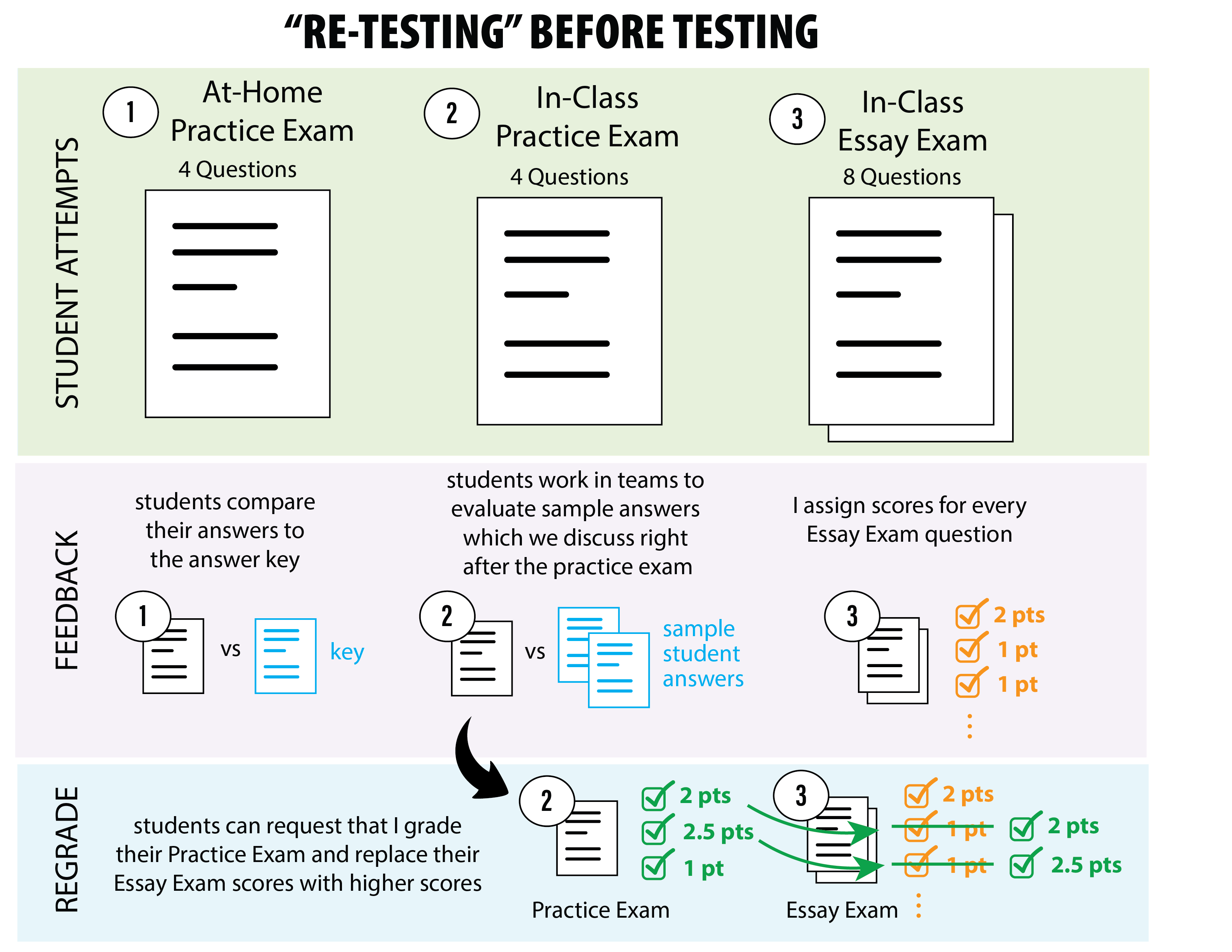
For each question on their practice exam that scores higher than a question on their Essay Exam, I replace the Essay Exam question score with the higher practice exam question score. For example, let’s say I scored Tom’s Essay Exam question 3 as “Revision Needed” (which earns 1 point in my scoring system). He requests that I grade question 1 on his practice exam, which I score as “Meets Expectations” (2 points). I replace one “Revision Needed” on his Essay Exam with a “Meets Expectations”, increasing his score by 1 point (out of 20 points total). Students can request that I grade all four of the questions on their practice exam if they think they earned at least a “Meets Expectation” on each one.
In this way, the practice exam is the optional re-assessment opportunity.
What I like
I like the way it supports learning for all students
I like that students get to practice the exam two times before actually taking it. The practice exams force students to engage in active recall, which is an effective study strategy.
I like that because the practice exams are built into our course structure, all students benefit from engaging in active recall, not just the students savvy enough to do it on their own as they study.
I like that because the in-class practice exam acts as the re-test opportunity, students take the practice exam seriously and actually try. This makes it more likely that they productively engage in active recall during the practice exam.
Since the practice exam occurs during regularly scheduled class time, I like that everyone has access to the re-test opportunity, not just the students who have the time to attend an optional re-test outside of class.
I like that one of the practice exams happens in the same classroom setting as the real exam, so students have a chance to acclimate to the testing environment with lower stakes before the real exam happens.
I like that students get to put their best foot forward
I like that what I actually grade (their effort on the Essay Exam) reflects the learning they’ve done after two practice exams, and so it should, theoretically, represent their most advanced level of learning. This is different than traditional re-testing, where the instructor grades a student’s first attempt, and the second (and third, etc).
I like that if students make silly mistakes on the Essay Exam, or if the wording of a question just doesn’t click with them, it doesn’t have to drag down their score. One time a student forgot to turn the page over, so she didn’t answer two questions on the Essay Exam. On a traditionally-graded exam, that would significantly reduce her grade, but with my re-testing option, she could replace those “Not Assessable” (0 point) scores with scores from two of her practice exam questions.
I like that this model makes my grading time sustainable
OK, real talk: Each semester I teach a 9-contact-hour course, which means I’m spending 9 hours per week in the classroom or lab with students. Those 9 hours don’t include the time I spend preparing for class, fielding emails, setting up and managing homework assignments, and inputting scores in the Learning Management System for my high-structure course that has many graded assignments. In reality, I spend roughly 15-18 hours per week on this one course. That doesn’t include the 8-9 hours it takes me to grade a set of Essay Exams (three times per semester).
I teach as an adjunct-by-choice, which means the pay is miserable2 and I have other demands on my time (notably, I’m writing a new General Biology textbook).
So, I don’t have a lot of time for grading.
I like that my re-testing before testing model reduces my grading time in several ways:
I grade students’ best effort, since they’ve already had 2 practice attempts to learn and improve. This reduces the number of regrades I need to do afterward.
Since there is no re-test opportunity after the Essay Exam, I don’t need to take the time to provide written feedback, I only provide scores on each question. This saves a lot of time (but there is a downside, see below).
When students request a regrade, I ask them to use the answer key to identify only those questions they think will earn a “Meets Expectation” or higher, so I don’t have to score every question on their practice exam, saving me time.
What I don’t like
I never give students individualized feedback. One of the four pillars of the Grading for Growth model is Helpful Feedback, because helpful feedback is essential for students to learn from their mistakes. But given the size of my class and the constraints on my time, I don’t see a way for me to sustainably provide individualized feedback to every one of my students.
Instead, I’ve designed the practice exam structure so students can learn from their mistakes by comparing their responses to example answers:
For the in-person practice exam, after they turn in their answers, I immediately provide sample student answers and they work in teams to assign a score to each one. This doesn’t give them direct feedback about their own work, but it does give them a chance to think about what the “right answer” is immediately after having written their own responses.
For the at-home practice exam, they are provided with the answer key after they submit their exam, and I trust them to do that comparison on their own (which I recognize is not ideal). I plan to improve this process by incorporating a structured self-review process into the practice exam homework assignment.
The other thing I don’t like is that my system does not offer a true re-test without a grade penalty. Since the practice exam is half-sized, students can get a maximum of 4 out of 8 of their question scores updated on their Essay Exam. I don’t see a way around this, because I make the practice exam half-sized so we have time in class afterward to discuss it. I don’t want to spend more class time on the practice exam, since we are already spending 3 full weeks (out of 16) on the essay exams alone.
It’s not a perfect system, but I think it does a good job of supporting equitable student learning through the assessment process within my time-limited constraints. If you have suggestions for how to improve the process, I’m all ears! And if you end up trying a similar re-test before testing model in your classroom, I’d love to hear how it works in your context.
Not everything you read on the internet was written by a human. For full transparency, here is how I used AI to help me write this post:
I did not use AI to help me write this post.
I have returned to strictly in-person, hand-written exams in response to the availability of generative AI. I have mixed feelings about this, but for now it is the only way I feel confident that I am judging my students’ actual work.
The only reason I can teach as an adjunct-by-choice is because my partner supports our family financially.
I really like this! I think your approach does a good job of balancing multiple attempts and what can become a very overwhelming number of questions/assignments to grade. I have a question about how the practice exam maps to the exam. Do all eight questions on the practice exam map to the unit exam? For example, by testing the same LO? Can students choose any question from the practice exam to regrade and replace the unit exam score?