
A Start, Stop, Continue Reflection for 2026
The changes I’m making – or not – in the classroom this year

Inspired by others who reflect on their teaching practices using a Start/Stop/Continue model, I’m sharing the teaching practices I plan to change or keep in the coming year.
For context, I teach a 40-person Introductory Biology course at a community college in NC. I teach part-time as an adjunct-by-choice. With my other professional time, I am co-authoring a new General Biology textbook for majors.
Start
This spring semester, I will start teaching using freshly-written chapters from the textbook I’m co-authoring. We have a complete first unit, which introduces topics related to the chemistry of life and evolution using an astrobiology lens. We ask questions like, “When searching for extraterrestrial life, why do scientists look for planets that have liquid water?” and “If life exists under the ice on Jupiter’s moon Europa, how could it get energy without sunlight?” These questions serve as a narrative chassis to introduce topics like hydrogen bonds and membrane biology.1
The material is still in rough draft form – notably, our production team hasn’t had time to make the rich set of multimedia we have planned – but I’m excited to see how our vision for interweaving narrative with course content and integrating scientific research into the story line works for my students.
Stop
I taught the same course this past fall semester, and it was the first time I tried balancing teaching with writing. (Last academic year, I took a “sabbatical” from teaching so I could focus on writing.) Combined with some personal challenges this fall, it was a real challenge keeping my head above water.2 In response, streamlining the time and mental load I spend on teaching is a top priority this year.
Don’t offer the Attendance Challenge again
I’ve been strongly opposed to grading for attendance, but last year I read a paper claiming that relative to de facto grading for attendance, letting students opt-in to grading for attendance can help boost attendance.
I’ve struggled with widespread attendance and tardiness issues since the pandemic, so last semester I instituted the “Attendance Challenge.” For students who opted in, if they had 3 or fewer absences3, I added 3% to their final grade, and if they had more than 3 absences, I subtracted 3%. Being more than 5 minutes late counted as an absence.
There were two things I didn’t like about the Attendance Challenge:
First, it required extra time and mental load for me to keep track of the attendance and tardiness for the two-thirds of students who opted-in to the Attendance Challenge.
Second, I didn’t like that it artificially boosted or reduced some students’ grades in a way that had nothing to do with actual demonstrations of learning. And guess whose grades were hurt by the Attendance Challenge? Those students who were already struggling.
So this semester, I won’t offer the Attendance Challenge again. (Though, I do wonder if it helped increase attendance…4)
Stop making separate lesson plan documents
In my active-learning centered “lectures,” I bounce back and forth between Powerpoint slides, whiteboard writing, and a document projector, all while orchestrating various in-class activities for the students. To coordinate all this, I write each day’s plans in a separate document, which I print before class. This lesson plan includes that day’s learning objectives, materials I need to bring to class, my minute-by-minute plan for what both I and my students will be during throughout the class period, and a seating chart for assigned teams. Here’s an example.
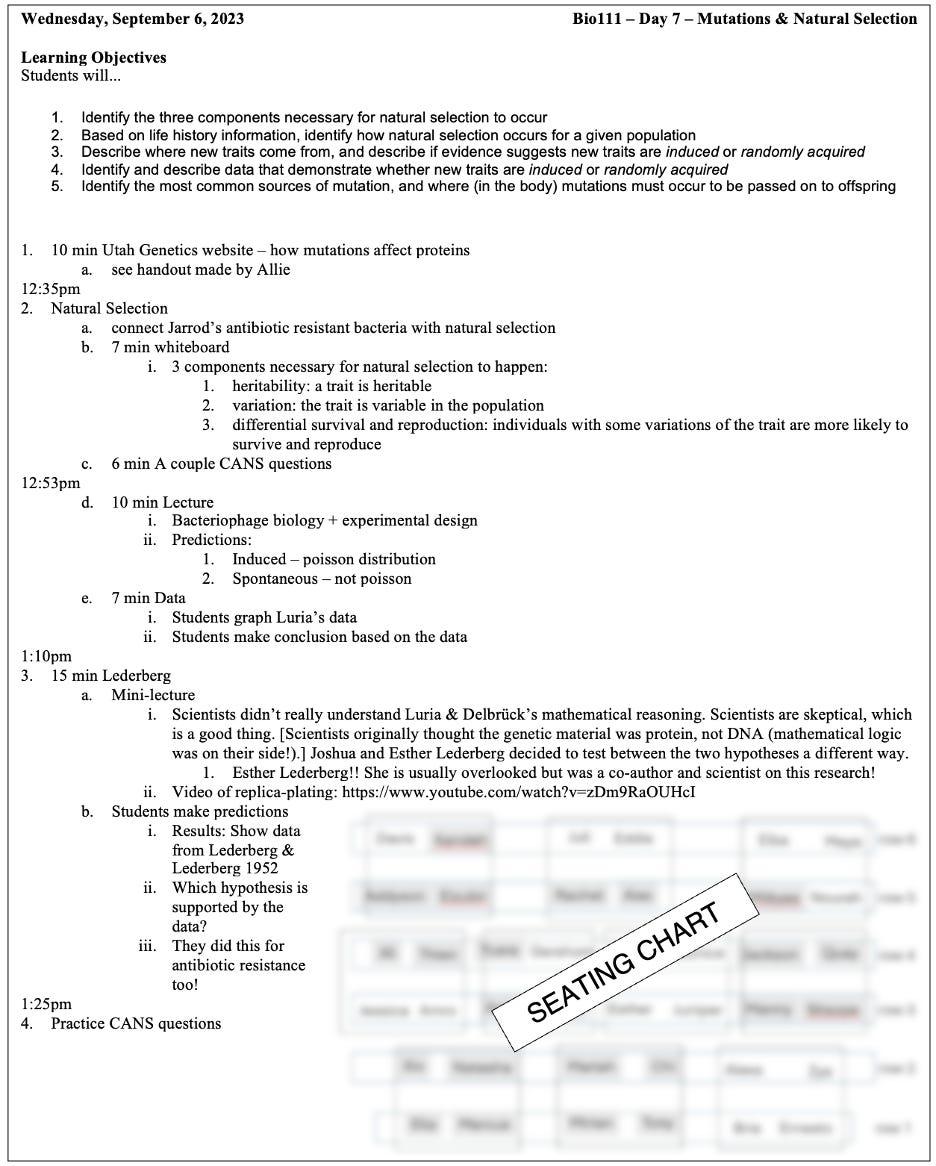
This fall semester, two things changed that made the lesson plan feel more onerous than helpful. First, I’ve been teaching long enough that I can come up with active learning activities on the fly, so I don’t need to meticulously plan every single one. I still prep materials for larger activities, but I’ve found that I can read the room and notice, They look confused, let’s do some Think-Pair-Share questions.
Second, when I was strapped for time this fall, I found it easier to have one document that was my guide through the lecture period, rather than my typical two (slides and lesson plan). Since I had to make Powerpoint slides anyway, I started using the slides as my guide. When I planned to write on the whiteboard or introduce an active learning activity, I simply inserted a slide for this (literally, “Dr. Dyer will write on the board about XYZ”).
So, going forward, I plan to use slides as my guide for the lecture and eliminate making and printing the lesson plan for each class period. I’m hopeful this will help streamline my prep for each day, but I’ll pay attention to whether I lose something important (bigger picture viewpoint? emphasis on learning objectives?).
Continue
I have two types of assessment in my course, and I designed them to support student learning in addition to assessing student understanding. I plan to continue using these assessment structures this year because I like the way they iteratively support learning.
Quizzes + Final Exam
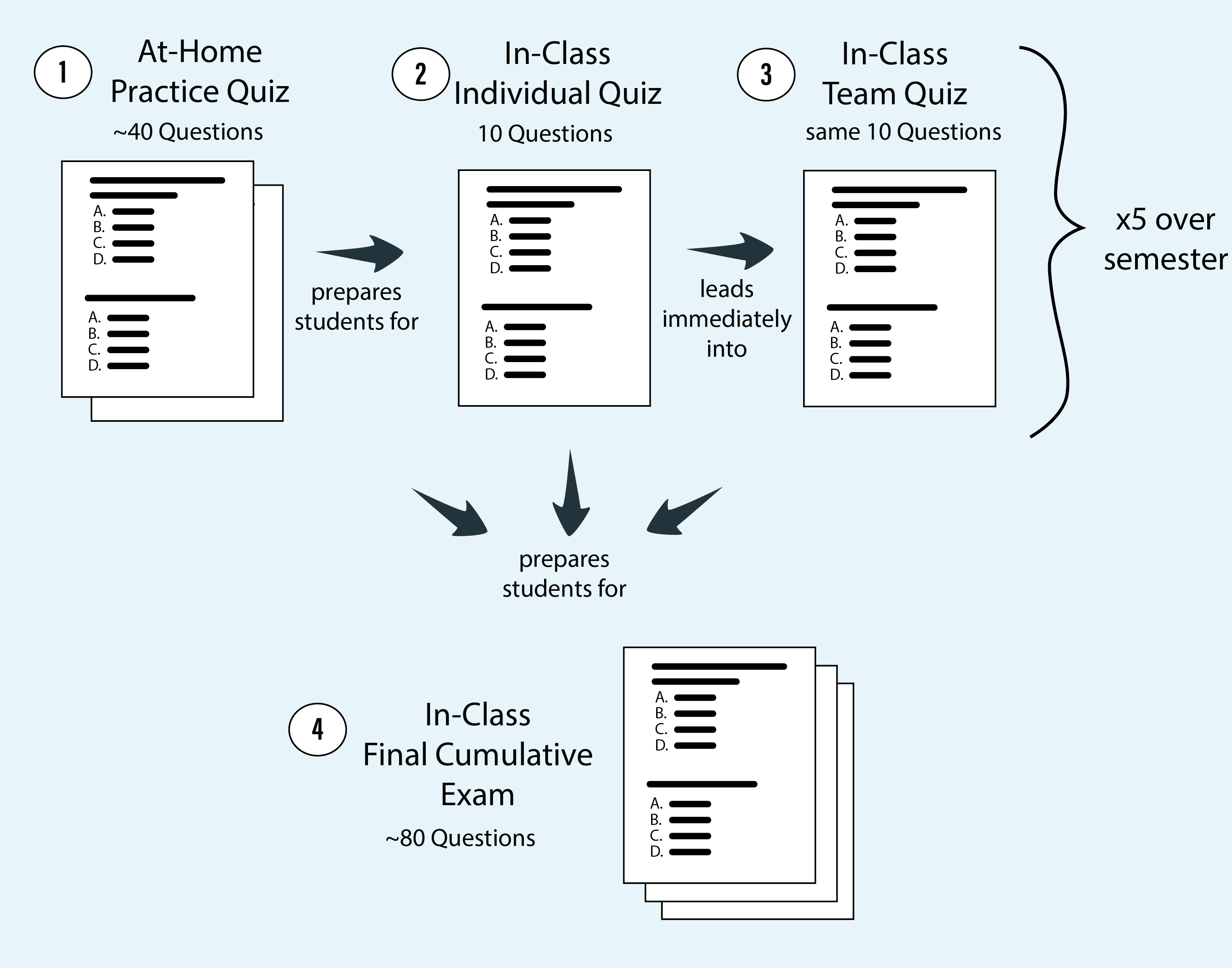
These assessments are focused on lower- to mid-level Bloom’s questions, mostly in multiple-choice format. Students engage in the assessment four times, successively:
1. First, they take a practice quiz online for homework, which includes around 30-40 questions. This is graded on completion only. The goal is for students to engage in retrieval practice and identify where they have gaps in their understanding.
2. We use the first 25 minutes of class to take the quiz in person. First, they take a 10-question quiz in class. They take five quizzes throughout the semester. The questions are identical, or very similar to, questions from the practice quiz.
3. Immediately after taking the quiz individually, they take it again, this time as a team. They use IF-AT scratch off cards to get immediate feedback. (This is a version of two-stage testing.) Afterward, we discuss the most challenging questions as a class.
4. At the end of the semester, they take a final cumulative exam, which has questions similar in content and format to the quiz questions.
Because I use Multiple Grading Schemes, students who do well on the quizzes can have those scores counted in their final grade, while students who don’t do well on the quizzes — but learn from the quiz-taking experience and demonstrate mastery on the final exam — only have the final exam score included in their grade.
I like that the quizzes are designed in progressive layers, from at-home practice to individual practice to team practice, to help prepare students for the final exam.
Essay Exams
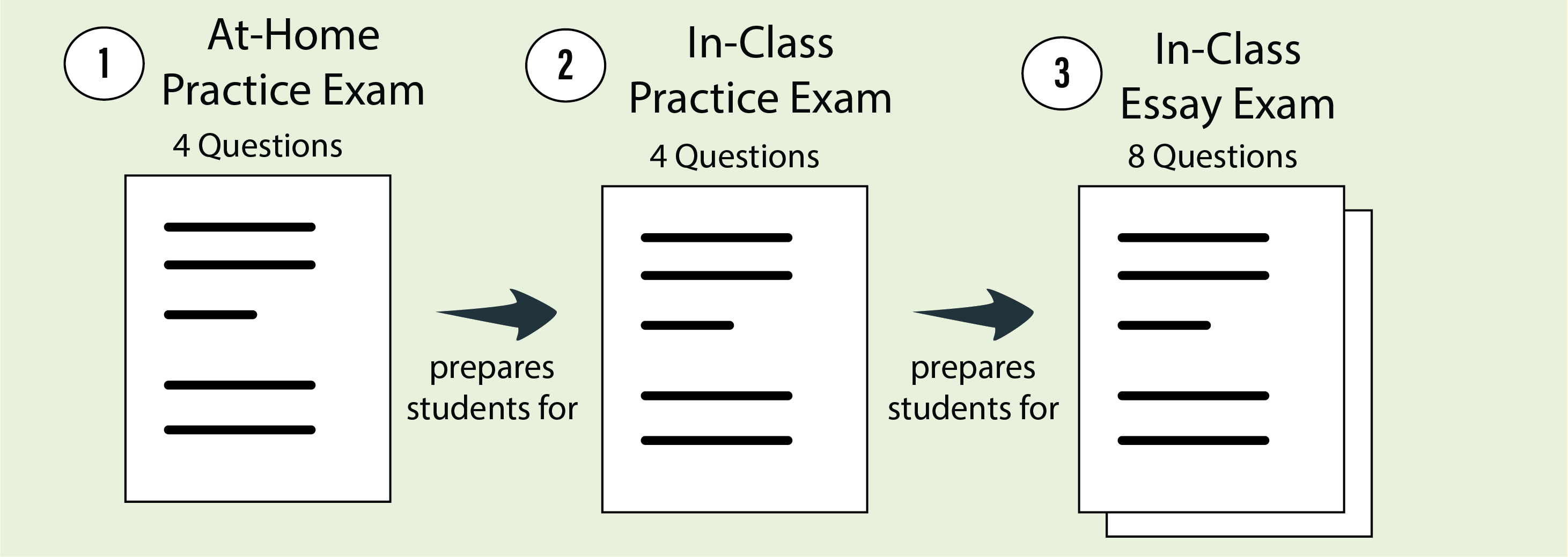
These assessments are focused exclusively on higher Bloom’s level open-ended questions that require paragraph-length responses. There are three Essay Exams over the course of the semester, and for each one, students engage in each assessment three times successively:
1. They complete a 4-question practice exam at home and after submitting their responses, can compare their answers to a key.
2. We use a whole class period for an in-person practice exam. We use half the class period for students to take a new 4-question practice exam, then we spend the rest of class discussing example student answers to each question.
3. The next class period, students take the real Essay Exam, which has 8 questions.
I’ve designed the Essay Exam structure such that if they are unhappy with their Essay Exam score, they can request that I score their practice exam as a kind of “re-test” opportunity. A longer blog post about that “pre-test as re-test” format is forthcoming.
I like these assessment structures because I’ve seen the way that – when students take the practice opportunities seriously – they help students learn and be better prepared for the assessments that actually end up counting toward their final grade. That’s why I plan to keep them.
Here’s hoping that my students learn more, and I do a better job keeping my head above water, in 2026.
Not everything you read on the internet was written by a human. For full transparency, here is how I used AI to help me write this post:
I did not use AI to help me with this post.
If you teach Biology and this textbook structure sounds exciting, you can sign up to learn more and/or join our Early Access Instructor group.
To illustrate my relative lack of work-life balance: At home, we recently instituted a rule for our kids that “you don’t get to do fun things (e.g. playing with friends or having screen time) on the weekend until your room is clean.” In response, my 10-year-old joked that it should go both ways: “Daddy, you don’t get to go climbing until you’ve done your chores, and Mommy, you don’t get to do work until you’ve done your chores.” I laughed, but also wanted to cry: My kids think the fun thing I want to do on the weekends is work!
There were ways to “erase” an absence by earning enough stickers on their sticker chart, which acts as a kind of grade-free extra credit system.
It’s possible that the Attendance Challenge did boost attendance and reduce tardiness, but the only way to know is to compare last semester’s overall attendance with the attendance from a similar course section that doesn’t offer the Attendance Challenge. Since I am required to keep track of attendance for all students anyway, I plan to compare last semester’s overall attendance rates with this coming semester’s attendance in a mini-experiment. I’ll likely report those results here next summer.
Love how your testing strategies emphasize practice!
I like to keep a very minimal set of lecture notes which I call my "Timing Notes." They consist of a table with two time columns (how many minutes into class are we now; how much time should this chunk take?) and the section or activity for each chunk. I keep a few notes on that document for reminding myself of what to prep before class - opening websites / simulations to avoid wait time, or demos to prep, or notes for something specific I want to remember to say. Pretty much everything I do is otherwise centered in my slides like you demonstrate (bubbles like "let's do a worked example on the Doc Cam"). I find this leaves me with enough flexibility that I can improvise when needed, but have enough structure and assurance that I'll hit the key points.
One page fits 2-3 class sessions, and I annotate these with notes for the next iteration. I keep them in Google Docs and include a link to the day's slides. I can thus share my timing notes with other faculty and everything outside of the LMS comes along for the ride, so they can see a sense for what we do without an overwhelmingly long doc.